


CIRCLE ONE
The Spectators
Emergencies become content. Feeling becomes evidence of goodness. Everybody is waiting for someone to do something.

Psychology / Allegory / The Modern World
A Journey Through the Nine Circles of the Modern Inferno
Dante had nine circles. He also had the enormous advantage of writing before readers could reply beneath the poem.
Human nature has changed less than its equipment. Wrath got broadband. Pride found analytics. Treachery hired legal and a communications team. Hell needed updating.
By Martin Rothery · Nine circles · 355 pages · £12.99 PDF · Also on Amazon
Instant download. One payment. Read today. · Also available through Amazon.
Most of the modern inferno is staffed by ordinary people.
They arrived carrying a justification, usually laminated.
Why Hell Needed Updating
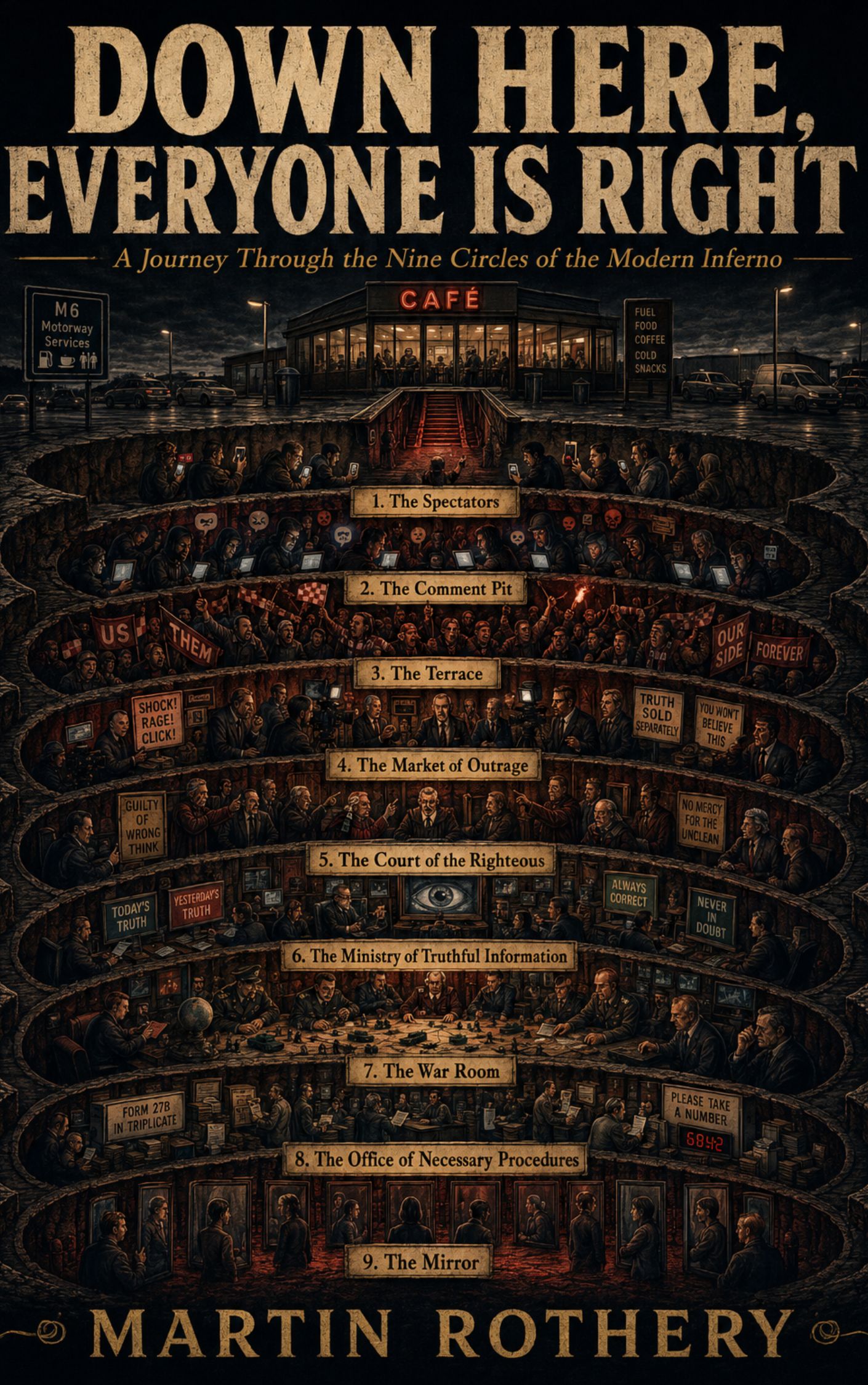
At two sixteen on a wet Tuesday morning, on the last stretch of a drive from Gdańsk to Chesterfield, Martin finds a grey door beside the toilets in a motorway service station outside Leicester.
Behind it is a staircase, a Porter with a brass luggage trolley, and nine circles of Hell redesigned for the modern world.
There are no devils with forks. There are people filming instead of helping. Trolls turning strangers into targets. Crowds borrowing hatred from one another. Markets selling outrage by the jar. Courts where everyone is righteous. Ministries where language makes the person disappear. War rooms where bodies become symbols. Offices where cruelty is processed correctly.
And beneath them all, a mirror.
What Kind of Book Is This?
The Central Argument
They arrive through adjustments small enough to explain.
A person becomes an avatar. A neighbour becomes a demographic. An opponent becomes a category. A civilian becomes collateral. A frightened applicant becomes a difficult case.
Each change in language makes the person easier to ignore, punish, process or sacrifice.
The book follows that disappearance — and asks what it requires from the rest of us while it is happening.
The Nine Circles
The upper circles are loud. They have screens, chants, slogans and excellent engagement figures. Lower down, people wear lanyards. Nobody raises their voice. The coffee is included in the meeting package.
Emergencies become content. Feeling becomes evidence of goodness. Everybody is waiting for someone to do something.
Strangers are reduced to profile pictures, labels and material. Cruelty learns to call itself opinion, truth or banter.
Belonging becomes tribalism. The crowd lends ordinary people a cruelty they might never have managed alone.
Attention is sold through emotion. Fear, disgust and certainty are packaged, measured and replenished before they expire.
A cause may be right while its servants become cruel. The accused changes, but the need for guilt remains.
Facts, implications and institutional reputation are processed through language precise enough to hide what happened.
People become targets, assets, threats and acceptable losses. Distance turns a life into a movable symbol on a map.
Rules designed to protect fairness become cover for absence. Every outcome is correct because every box was ticked.
The obvious villains are not at the bottom. The deepest circle contains the people who knew, had some power, and did not act.
From the Book
“Her life is not a public place.”
“A cause can be right and its servants cruel.”
“Spectacular wickedness gets the portraits. Ordinary abdication keeps the lights on.”
“You may keep your explanation. You will not be allowed to hide inside it.”
The Book Refuses the Easy Exit
This is not a book that flatters one tribe by placing all the monsters in another. The authoritarian, the revolutionary, the nationalist, the cosmopolitan, the believer, the sceptic, the official and the rebel can all use a good cause to stop seeing the person in front of them.
Understanding how a person became dangerous does not make the danger harmless. Compassion does not require surrendering judgement. It requires remembering that judgement is being made about a human being, not a disposable shape cut from the argument.
What the book asks is harder than neutrality: stay human while you oppose.
Who This Is For
Use the map outwardly when it helps you understand a system or interrupt harm.
Use it inwardly first.
About the Author
Martin Rothery has spent thirty-eight years studying what people do beneath the explanation they give for doing it. He is a therapist, author, creator of Sanomentology and founder of the Nine Realms Institute.
In Down Here, Everyone Is Right, he replaces the safe distance of a conventional psychological argument with a journey. The reader smells the room, hears the excuse and eventually notices that one of the voices sounds familiar.
Read More About MartinAlso by Martin Rothery
Want the full architecture of change?
Explore Boundless →Get the Book
The door is beside the toilets. The Porter is waiting. The trolley is already making its way down the stairs.
One payment. Download and begin reading today.
Secure checkout. Download link sent immediately.