“I avoid conflict.”
The question is not whether you suddenly become confrontational. It is whether you can build an identity capable of tolerating disagreement without automatically disappearing from it.
Realm Three · Personal Edition
A surprisingly large part of your life is organised around an answer you rarely stop to question: “Who am I?”
Personal Edition — £97The Identity Realm is not a personality test. It is a map of the deeper patterns that influence what feels natural, threatening, possible, impossible and unmistakably “you”.
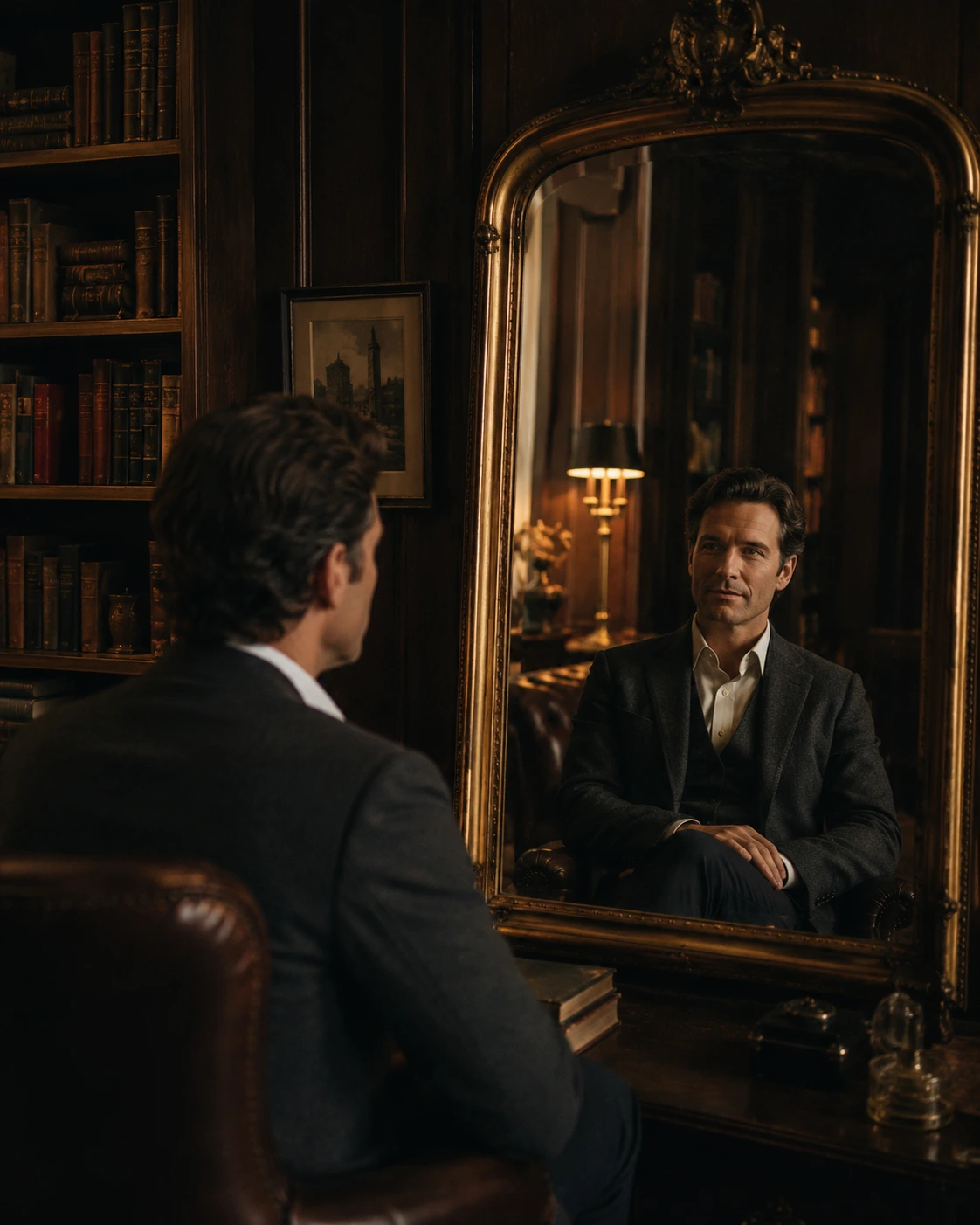
You do not have to spend the rest of your life faithfully impersonating the person you became in order to survive the first half of it.
Identity can be chosen more consciously than most people realise
Have you ever dreamed of becoming somebody quite different from the person you have learned to be?
Perhaps more courageous. Less compliant. Less willing to spend half your life saying yes when every part of you means no. Perhaps you want to become more confident, more decisive or less frightened of disappointing people.
Or perhaps your difficulty sits at the other end. You are very good at being strong, certain and self-contained, but rigidity is beginning to cost you. You would like to become more empathetic, more flexible, easier to live with, or simply more able to let another person be right without experiencing it as a constitutional crisis.
Thoughts like these tend to appear when life changes. A relationship ends. A career stops fitting. You become a parent. The children leave. You lose somebody. You succeed at something and discover that the identity which got you there is not necessarily the one you want to live inside afterwards.
Most people think identity is something they discover. The Identity Realm starts from a more useful possibility: much of what feels like “just who I am” is a structure built from roles, repetition, expectations, adaptations, loyalties, defences and decisions made long ago.
And structures can be changed. Successful people often do something the rest leave to accident: they become deliberate about identity. They decide which qualities need strengthening, which old roles have finished, which parts of themselves have been overused, and what kind of person the next stage of life actually requires.
The Identity Realm gives you tools for doing that consciously.
The Archetype Codex
Identity feels solid because you have been living inside it for a very long time.
You know the roles you naturally fall into. You know the situations that make you shrink, take charge, explain, rescue, rebel, withdraw, perform, please or push forwards. Some parts feel so familiar that you stop experiencing them as patterns at all.
They simply become you.
The Identity Realm looks underneath that familiarity. It explores identity architecture: the deeper structure beneath behaviour, emotional response, instinct, perception and the roles you repeatedly occupy.
The training uses archetypal patterns as a practical map. It looks at how those patterns interact with childhood, family, culture, success, failure, relationships and circumstance; how some become dominant while others disappear into the shadow; and how the resulting architecture influences what you notice, expect, tolerate and attempt.
Just imagine that you have a way to stop treating identity as something handed to you once and permanently sealed. And that you can reshape it into an identity that supports what you want, need and desire.
You have free will. So why should who you are be the one thing you never get to choose?
What identity change means here
It means noticing the roles and patterns that have become so familiar they feel permanent, then becoming deliberate about the qualities and responses the next part of your life actually needs.
The question is not whether you suddenly become confrontational. It is whether you can build an identity capable of tolerating disagreement without automatically disappearing from it.
Confidence may be something you have learned to withhold from particular situations rather than a permanent measurement of who you are.
An identity that once kept life together can become expensive when it no longer allows help, softness, uncertainty or dependence.
Family, class, culture, profession and old relationships can quietly define the borders of what feels available to you.
Repetition is powerful evidence of a pattern. It is not necessarily evidence that the pattern is biologically fixed.
Transitions can remove an old role before a new identity has formed. That gap can be uncomfortable and also unusually creative.
Have a look inside
Identity is one of those subjects that can sound abstract until you see how much of everyday behaviour is organised around who you believe yourself to be. The preview lets you experience the teaching directly before deciding whether to continue.
The menu shows the full course structure. Preview lessons are available to watch; the rest remain visible and locked so you can see the depth of the programme. On mobile, use the Preview Lessons tab.
Watch the unlocked lessons here and see the full course structure alongside them.
The twelve universal archetypes
The Realm works with twelve archetypal structures. You carry all of them. What makes your architecture distinctive is the way they are arranged, expressed, suppressed and combined.
The instinct to rise, confront challenge and grow through adversity.
The instinct to seek freedom, expansion, novelty and discovery.
The instinct to connect through intimacy, beauty, feeling and depth.
The instinct to protect, support, nurture and stabilise.
The instinct to understand, question, investigate and clarify.
The instinct to transform, reimagine and perceive hidden possibility.
The instinct to organise, lead, structure and shape direction.
The instinct to challenge, disrupt and break what no longer works.
The instinct to trust, hope and remain open to possibility.
The instinct to express, imagine, design and bring ideas into form.
The instinct to bring play, humour, energy and release into heaviness.
The instinct to belong, connect, collaborate and build community.
From the Identity Realm

One of the things I’ve noticed in personal development is that people talk about archetypes all the time. You hear the language everywhere. But usually it stays pretty abstract.
What Martin Rothery has done with the Identity Course and the Nine Realms Institute feels different because he actually gives the whole thing a structure. You’re not just told, “step into this archetype.” You start to understand what that archetype actually is, what qualities define it, and how you can access those qualities in yourself.
The exercises were especially useful for me because there were moments where I’d realize, “Oh, this is already in me.” Then there are other moments where you start seeing a version of yourself you could actually grow into.
I’ve gone through a lot of personal development work, and I honestly haven’t seen archetype work laid out this clearly before. If you’re interested in identity and in becoming more intentional about who you’re becoming, Martin gives you the roadmap.
All you want to do is keep going through the course.

The Identity Stack
Identity has layers, and the relationship between those layers matters.
The manual describes a Core Identity at the centre of the architecture, supported and modified by other patterns. Some are reliable parts of how you move through life. Others appear only in particular contexts. The result is far more useful than trying to reduce a human being to a single type.
When the stack is coherent, you tend to feel more like yourself across changing circumstances. When important parts conflict or disappear, the result can feel like fragmentation, overcompensation or the peculiar experience of watching yourself behave in a way you don't actually like while somehow continuing to do it.
Shadow Architecture
Identity is shaped partly by what was allowed to develop and partly by what learned to stay out of sight.
A questioning child can learn that questions cause trouble. A caring child can learn that usefulness earns belonging. A natural leader can learn that visibility is dangerous. A playful part can become inappropriate. A rebellious part can be punished into silence.
The underlying pattern may still be there. It simply moves into the shadow and begins expressing itself less directly.
The Realm explores those shadowed patterns without treating them as evil hidden selves waiting to ruin your afternoon. Often they are parts of the architecture that adapted intelligently to an environment and then kept using the same strategy long after the environment changed.
Inside the training
The Realm moves from recognising identity architecture to understanding its layers, then into deliberate reconstruction and integration.
Recognising the structure beneath behaviour, emotional response, perception and the automatic self that appears before conscious explanation catches up.
Exploring the relationship between natural archetypal tendencies and the environments that amplified, suppressed or reshaped their expression.
The twelve recurring identity structures and the different instincts, meanings and behavioural tendencies they bring into the wider architecture.
Identifying the most consistent organising pattern in your own life: the identity centre around which many other responses are arranged.
Core, secondary, tertiary and situational patterns, and the way their relationships create coherence, versatility or internal conflict.
Understanding the patterns that were suppressed, punished, overdeveloped or pushed out of ordinary expression.
How identity affects what you notice, expect, attempt, tolerate and interpret, changing the version of life that feels available to you.
Dissolving outdated identities, constructing a chosen centre of gravity and learning to live from the architecture you are deliberately building.
Constructing identity
Some identities were useful once. That does not make them permanent.
The manual explores identities formed through expectation, belonging, protection, survival and circumstance. A pattern can make enormous sense in the environment where it formed and become remarkably unhelpful twenty years later.
Identity work therefore involves more than spotting an archetype and admiring the label. You begin asking why a particular identity developed, what purpose it served, what it still protects and whether it fits the life you are actually living now.
From there, the training moves into deliberate construction: choosing the direction of the person you are becoming and building an architecture capable of supporting that life.
Personal or professional?
You receive the full relevant Identity Realm training as a self-directed Personal Edition.
You can use the model, exercises and Archetype Codex to explore your own identity architecture, shadow patterns, relationships between archetypes and deliberate identity construction.
The purchase does not include practitioner certification, professional-use rights or individual practitioner support. Professional application of the Identity Realm with clients sits inside Boundless Practitioner.
Realm Three
Understanding identity does not mean erasing your history or inventing a fake new personality.
It means seeing the architecture clearly enough to know which parts still belong, which parts have been running on old instructions and which capacities you are ready to bring further into your life.